Australia has a long and proud tradition of live television. From the rollicking energy of morning shows on Seven and Nine, to the measured gravitas of ABC News 24 and the sharp commentary of Q+A, Australian broadcasting covers an extraordinary range of formats, tones, and audiences. And across that breadth of programming, one thing remains constant: the occasional, entirely human moment when a microphone stays on just a little longer than anyone intended.
Hot mic incidents in Australian broadcasting are not common — but they are memorable. When they do occur, they tend to generate a reaction that is distinctly Australian in character: good-natured ribbing, a bit of online noise, and then a collective shrug that is far more forgiving than the incident might warrant in other countries. Australians, on balance, tend to like their broadcasters a little bit human.
The Morning Rush and the Backstage Slip
Breakfast television in Australia operates at a demanding pace. Productions like Today on Nine Network or Sunrise on Seven are multi-hour live marathons, blending hard news with lighter lifestyle content across a production schedule that begins well before dawn and leaves little room for the kind of careful preparation that characterises evening bulletins.
In this environment, hot mic moments are perhaps more common than producers would like to admit — though most are caught before they reach the broadcast feed. In one well-circulated incident, a technical lag during a segment change allowed viewers to briefly overhear an exchange between a presenter and a floor manager about the timing of an upcoming segment. The exchange was brisk, professional, and entirely mundane — but it landed on air nonetheless.
The reaction from the presenter was immediate and characteristically breezy. A quick acknowledgement, a light joke at their own expense, and the programme moved on. That response — unfussy, self-deprecating, and fast — seemed to go down well with Australian audiences, who tend to have limited patience for over-earnest apologies and considerably more time for broadcasters who can laugh at themselves.
The Australian response: What sets hot mic incidents in Australia apart is less the content — which is usually unremarkable — and more the cultural expectation that the presenter will handle it with good humour and minimal fuss. Overcorrecting is often worse than the original slip.
ABC News and the Unintended Commentary
The ABC occupies a unique position in Australian broadcasting. As the national public broadcaster, it carries a level of trust and accountability that places its presenters under particular scrutiny. This makes hot mic incidents at the ABC somewhat more consequential than similar moments at commercial networks — but it also means that the audience, when they do occur, tends to be watching closely enough to notice every detail.
In one incident during a live news segment, an ABC correspondent who had just completed an outdoor live cross was briefly heard through their still-active microphone making a quietly exasperated comment about the conditions during the shoot. The remark — less than ten words, entirely understandable given the context — was caught by the broadcast feed in the seconds before the audio was muted.
Audience reaction was overwhelmingly sympathetic. The ABC's social media channels saw a wave of supportive comments from viewers who had worked in outdoor conditions and entirely understood the frustration. The correspondent addressed it on their next appearance with a rueful smile and a single sentence of acknowledgement. The incident was over within 24 hours, replaced in the news cycle by something considerably more significant.
Commercial News: When the Interview Doesn't Quite End
Live news interviews at commercial networks — Nine News, Seven News, Ten's The Project — are tightly choreographed: a defined question sequence, a predetermined duration, and a planned hand-back to the studio. What is less predictable is the thirty seconds after the formal sign-off, when the camera has cut away but the microphone is often still transmitting.
A segment producer at a major Sydney commercial station described the phenomenon with characteristic directness: "The interview ends on camera but the mics stay live for a bit because you don't know if the presenter's going to need to add something. Most of the time nothing happens. Every now and then, someone says something you really wish they hadn't."
The most noted Australian commercial hot mic incidents have involved reporters and correspondents rather than studio anchors — partly because studio anchors are under more constant audio supervision, and partly because remote reporters operating with smaller crews have less support infrastructure around them. A journalist conducting a live cross from Parliament House or a natural disaster site is managing an enormous number of variables; microphone discipline is sometimes the variable that slips.
Panel Shows and the Calculated Risk of Informality
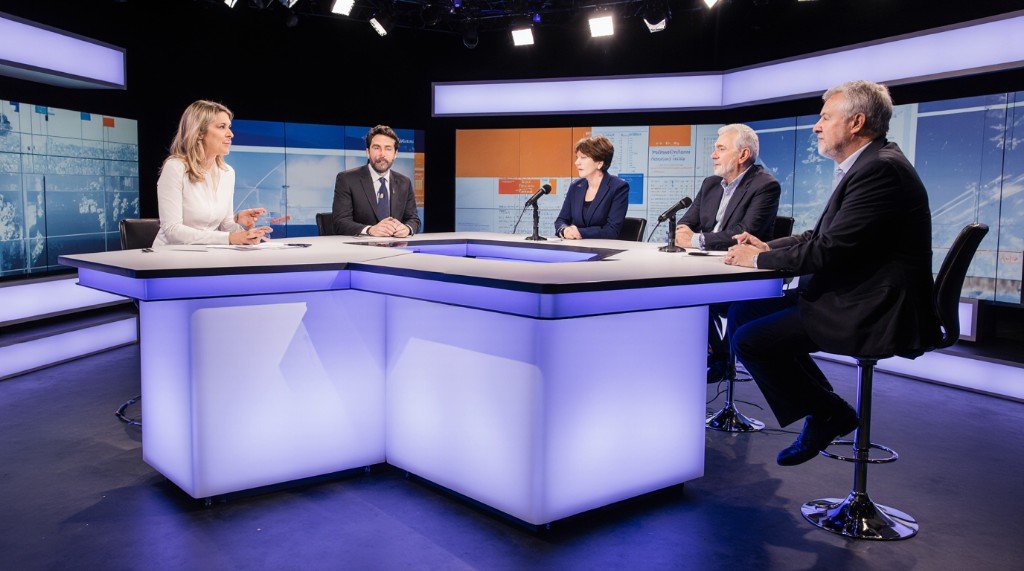
Australian panel television — Q+A, The Project, Insiders on ABC — operates on an implicit contract with its audience: the format is designed to feel conversational and spontaneous, even when it is carefully structured. This creates an interesting paradox. Panellists are expected to sound natural, unguarded, and direct — but within the boundaries of broadcast-appropriate content.
Hot mic moments on panel programmes are a particular category of their own. Because the format already accepts a degree of informality, the threshold for what constitutes a "slip" is different. A sharp comment between panellists that lands on air during what was meant to be a break might generate a moment of collective awkwardness — but it is often absorbed by the format's inherent looseness without significant consequence.
Several Australian panel presenters have noted publicly that the hardest part of live panel television is not the broadcast content itself, but the three minutes before and after — when the set is still live, everyone is still miked, and the adrenaline of the conversation hasn't yet dissipated.
Why It Keeps Happening — and Why It Probably Always Will
Despite better training, improved technical protocols, and considerably more sophisticated audio management than was available twenty years ago, hot mic incidents continue to occur in Australian broadcasting. The reasons are structural:
- Microphone management in fast-moving productions: In live productions with multiple concurrent feeds, dedicated microphone management is rarely one person's sole job. It competes with camera direction, rundown management, and the constant stream of communication from the control room.
- The assumption that clear means clear: Broadcasters routinely interpret "camera clear" as meaning their microphone is also inactive. In many production setups, these are separate technical states managed by different people.
- Remote and outdoor broadcasts: When reporters are working from outside the studio environment — a press conference, an outdoor live cross, a remote satellite feed — the technical control available to the production team is reduced. Microphone cut-off is less reliable, and the lag between a signal being sent and being actioned is longer.
- The scale of Australian geography: Broadcasting across a continent-sized country with multiple time zones and significant remote coverage amplifies the technical challenges inherent in live production. Signal routing across long distances introduces latency that affects audio switching in ways that are less common in more geographically compact broadcasting environments.
What Australian Audiences Actually Want
Research into Australian television audiences consistently finds that authenticity rates highly as a valued quality in broadcasters. Viewers want presenters who feel genuine — who appear to actually mean what they say, who react in real time to what they hear, and who don't seem to be performing composure rather than feeling it.
There is a tension here with the hot mic problem. The behaviours that make a presenter feel authentic — candid reactions, natural conversation, unguarded commentary — are exactly the behaviours that create risk when a microphone is unexpectedly live. Managing that tension is one of the core challenges of professional broadcasting.
The most successful Australian broadcasters are those who have found a way to be genuinely warm and natural on air while maintaining enough discipline to prevent that naturalness from becoming a broadcast liability. It is a harder skill to develop than it looks, and hot mic incidents — when they happen to experienced professionals — are a reminder of just how difficult the balance is to maintain.
The Microphone That Never Fully Sleeps
Every broadcaster, at some point in their career, has a hot mic story. It might be their own, or a colleague's, or something witnessed from the control room — but the story exists, and it is told with the particular mixture of horror and hilarity that attaches to professional near-misses.
For Australian broadcasting, these stories are part of the industry's character. They humanise a profession that can sometimes appear hermetically sealed behind studio glass and editorial protocols. They are a reminder that behind every clean, confident broadcast is an environment of organised complexity — and that in that environment, the unexpected will always find a way in.
The rule that every broadcast professional learns early, and re-learns periodically throughout their career, remains the simplest and most important: treat every microphone as live until you have personally confirmed otherwise. Not almost confirmed. Not probably confirmed. Confirmed.